My family will be studying the 19th century in the fall, and I’m excited to share my 1800s Black history books on enslavement, the Civil War, and Reconstruction with you here. Sharing African American history resources by time period is becoming a bit of a tradition, and I have to admit that it’s pretty fun!
I enjoy having a community of parents and teachers who want to share the stories and voices of Black people with their children and students. And this year is even more special than usual because I’ve also authored a new book, A PLACE TO BELONG: Celebrating Diversity and Kinship in the Home and Beyond, that will help ALL families integrate this type of inclusive learning into their home environment in a natural and loving way through the years. Please consider supporting my ongoing work in this area by purchasing a book today.
Below are some important ideas to consider before reviewing my selection of Black history books. Please feel free to ask questions in the comments if there’s something you’re curious about or don’t understand.
Grades/Forms
These plans cover 1800s Black history books for the following children:
- 7th grader (Form 3)
- 6th grader (Form 2A)
- 4th grader (Form 2B)
- 1st grader (Form 1B)
First grade explained
My first grader will fully participate in morning time, so he’ll experience the picture books with the family, but he’ll also have his own separate history plans. He’ll be studying Native Americans, in general, with a special emphasis on Cherokee life (then and now) because of where we live (Georgia). He’ll also be going through the Amazing Africa Heritage Pack, studying Black Cowboys, and completing a good chunk of Joyful Generations, my most recent Heritage Pack, which was written with him in mind. Preorder my book to get FREE Heritage Packs!
Form 1 notes
I know that some of my readers will have 2nd and 3rd graders in the fall. I’m not specifically sharing books for Form 1A in these plans, but the picture books are relevant for all ages. You can also consider the chapter books that I’ve selected for my 4th grader as read-alouds. And if you’re open to covering more than just this time period, the Joyful Generations Heritage Pack would be a perfect addition to either grade.
Combining children
When I’m reading aloud, I’ll read the same books to everyone. But because my older children have been through this period before, you’ll see a good bit of splintering with their independent reading books. For example, my 4th grader will always be reading different books than his 6th-grade sister even though they’re both Form 2 students and could easily be assigned the same readings. This is partly because of the drastic differences in their reading abilities but also because the girls have already read so many of the books that I would like my son to experience. I also already own the books, so there’s no financial incentive to combine them. In your family, it may be possible (and therefore advisable) to combine your students more than I have, as you’re able.
Overscheduling 1800s Black history books
1800s history and historical fiction are some of my 6th grader’s favorite things to read. It’s what she chooses to read in her free time, so you’ll see a heavy portion listed for her. I’ll give her the free reads stack, and she’ll choose which ones to read and when, but by the end of the school year, she’ll finish them all. My other kids are less likely to choose to read this literature in their free time, so you won’t see as many assigned selections for them. I’m only giving them what they’ll finish during their school lessons and periodic free reading. I just want you to understand what you’re seeing and why it looks the way it does.
Free reads
I have “free reads” listed in several categories below. These are excellent books that I want my kids to read, but I’m not going to assign them due to time. They are just as good as the books that I’m assigning, so don’t hesitate to swap titles due to availability, pricing, or preference.
Out of print 1800s Black history books
I’m aware that several of the books listed below are out of print and cost-prohibitive. I always shop my own bookshelves before purchasing new books, so my selections reflect what my family owns. But I can assure you that I purchased these books over the years at very reasonable prices, and I don’t recommend that you pay a ton of money for any of them so please don’t feel pressure to do so. In most cases, you can read the book for free on archive.org, check YouTube for picture books read aloud, choose a different book about the same person or topic, search bookfinder.com for the lowest prices on the web (My secret weapon!), or skip a hard-to-find book in favor of another option from the ones that I’ve shared. There are PLENTY to choose from.
Field trips, videos, eBooks, and audiobooks
I’ve always considered field trips to be an important aspect of our homeschool life. The pandemic has complicated that in many ways due to closures and travel difficulties, but we’ll continue to integrate visits to historic homes, museums, performances, and other notable locations/experiences into our Black history studies. I regularly use YouTube videos (We have ad-free YouTube Premium), documentaries, and movies to add learning opportunities to my lesson plans. My kids read hard copies of most of their books. My younger daughter occasionally enjoys reading on her Kindle, so I’ll provide both versions when the eBook is available at the library. My older daughter likes listening to her historical fiction on audiobook while she works on handicrafts, but otherwise, she also prefers a hard copy, so I try to provide her with both versions when reasonably possible (we have an Audible subscription).
Sensitive material
My three older kids already have a strong foundation in their knowledge of enslavement and all that it entailed. We’re always building upon that foundation and continuing to deepen their understanding. If your kids have never studied this type of material, it would be wise for you to spend some time preparing them for what they’ll encounter rather than just jumping right into these books. Consider going through the Heart & Soul Heritage Pack to give them an overview of the history of Black people in America so they’ll know what to expect. It’s really interesting, so you can even do it over the summer without complaints if you don’t school year-round. Get the Heart & Soul Heritage Pack for free if you preorder my book.
Freedom
You have the freedom to use as many or as few of these books as you’d like. You can use them as I’ve suggested or in an entirely different way. I share my plans each year to give other families and teachers ideas and to help them save time, but my way is not the only way. You know your children best.
Now, let’s get onto the good stuff!
1800s Black History Books
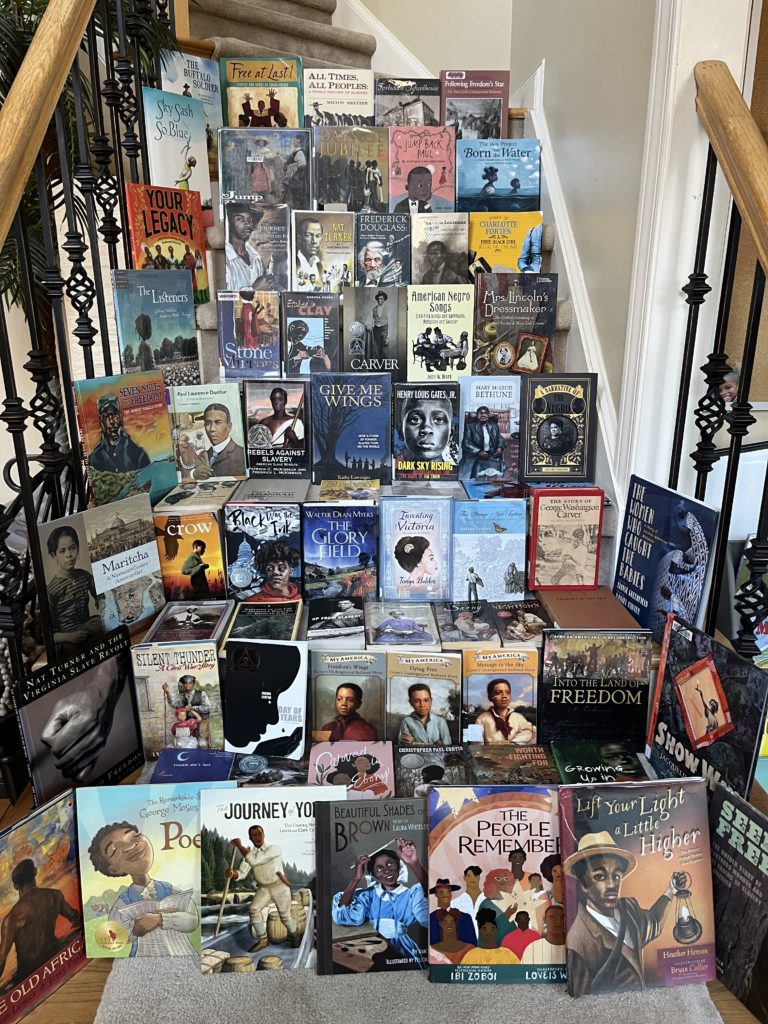
We’ve adopted a four-year history rotation modeled after Charlotte Mason’s, but adapted for American students. My kiddos will experience each rotation 3 times during their school years, going deeper each time. The time periods studied are as follows:
- Rotation 1: 800 – 1650 AD (Grades 5-12 also study 3500-550 BC)
- Rotation 2: 1650 -1800 AD (Grades 5-12 also study 550-100 BC)
- Rotation 3: 1800 -1900 AD (Grades 5-12 also study 100 BC-350 AD)
- Rotation 4: 1900 – present (Grades 5-12 also study 350-800 AD)
Here are direct links to the booklists containing each element of my family’s Black history plans covering 1800-1900 AD:
.
Reading schedule
As many of you already know, I don’t love creating reading schedules. I like to have them; I just don’t like to make them. But guess what? As with the last two years, my awesome friend Laura has graciously shared the reading schedules below (books broken out by weeks and page numbers) that she’s put together using the books that I’ve listed in this post. THANK YOU AGAIN, LAURA!!!
.
Disclaimers
I have not read all of these 1800s Black history books from cover to cover. I’ll eventually pre-read many of them, but I can’t do it all at once upfront. I try not to share books on my site until after I’ve read them, but so many of my online and real-life friends are covering the same historical time period in the fall, and they’re ready to begin planning. Please know that if I find something egregious within the pages of any of my recommendations, I’ll run back here and update the post. I don’t anticipate that happening though because, as with previous years, I already have all the books sitting here with me, and I’ve done a pretty thorough preview of the ones I haven’t read.
There are SO MANY more books I could include in our plans, but there is only so much time to devote to reading in our days. My goal in sharing is not to say that these are the best and only Black history books on enslavement, the Civil War, Reconstruction, and the people who lived in these times. I’m simply sharing my family’s plans with the hope that they will inspire you (and save you time!) as you prepare for the next school year. Please feel free to drop additional ideas (or questions) in the comments below so we can all benefit.
.
You can find me on Instagram @heritagemomblog. I hope to see you there!
.
Oh gosh you’re a goldmine! I just found you via IG and wow! I’m excited to peruse your blog and preorder your book. My kiddos and I will be deep diving into American history in our coming school year, and while we’ve discussed bits and pieces of black history we’ve yet to dig deep. I’m thankful that you have poured so much energy into crafting such a rich set of resources. I experienced a typical white-washed history education and I’m so glad that I get to learn alongside my children about the hard truths of our country’s history (and present!) thank you so much!
You’re so welcome! I’m happy that you found my little corner of the Internet. I hope that you find plenty of things here that can help your family on this journey.
I’m so excited for this! We are doing the same time period next year and this exactly the type of resource I was hoping to find!. Thank you for putting this together and making it available!
I’m glad that you found just what you were looking for! There are so many people on the same rotation, and I think that’s fantastic. It makes it much easier for us to share resources.
Amber, Beloved thank you so very much for sharing these titles with us all! Much love my Sista!❤️
You are so very welcome! I love that you love them 🙂
Amber! I just stumbled across your page on IG and I couldn’t be more thrilled! We’re doing Charlotte Mason homeschooling beginning this fall and my one hesitation with CM and Classical Ed has always been the Euro-centric nature… like, what was going on in the rest of the world when the Greeks and Romans were around? Certainly that must be worth studying, too! Finding your blog has been like opening a treasure chest. Thank you!
I’m wondering how you approach your ancient history rotation with your older kids. Do you use additional cross-cultural ancient history books/resources or do you find that AO/Alveary already offer that in their selections? THANK YOU!
Hi! I haven’t tackled changing any of the Alveary ancient history books. We’ve always done what they recommended, and so far, it feels like the books have explored multiple cultures across the world at a good pace. However, ancient history is a weakness of mine, so I don’t know what I don’t know, and I may have a blindspot there. And also…WELCOME!!! I’m so glad that you’re here.
Thank you so much for this- We are in A Gentle Feast Cycle 3 this year which covers the 1800s, and I am thrilled to find extra reads to add to this already rich curriculum!
I’m so glad that you found something useful here!
Amber. Thank you so much for sharing all of this with us! I am trying to re-educcate myself about all the untold stories that I didn’t get to learn about she I was in school. It is s exciting to do it alongside my kids. We are going to be covering this century this coming year, and it seems that everything you are suggesting is African American history. While I will enthusiastically be using some of these suggestions in our study of American history, I was wondering about World history.
I was wondering if you had any book suggestions for how to approach the topic of colonialism in Africa, but not told by the colonizers. There is s much about the exploration of and scramble for Africa, but I want to make sure that I am presenting it in a balanced way. How do you handle that topic? Thanks!
Hi! I don’t have nearly as many books in that realm. I’m not sure about the ages of your children, but I can suggest African Beginnings and Building a New World by Jim Haskins and Born in the Water by Nikole Hannah-Jones and Renée Watson.
Hi Amber! You mentioned field trips in this post. I’m planning a trip with my family to Atlanta next month. We’re studying the 1800s this year and have used many of your suggested resources. Any specific field trips you would recommend in the Atlanta area? Always so appreciative of your help!!
That’s a great question! Atlanta is most known for its civil rights historic sites, but my top recommendation for 1800s history is the Atlanta History Center. It’s one of our favorite places in town. Call ahead and see if there will be any special events while you’re there. There’s an exhibit on the Civil War inside and a replica of a slave cabin on the grounds, along with other out buildings. They also have a huge multimedia painting experience that tells the story of the 1864 Battle of Atlanta (Civil War). That’s a separate timed ticket, so plan ahead to make sure that you can see the “Cyclorama” while you’re at the museum. There are plenty of grounds and outdoor places to picnic if you want to bring your own food, but there’s also a healthy cafe with fresh soups, salads, and sandwiches in the museum (Delicious but plan for about $15 per person. I usually pack the kids’ food and buy mine at the cafe :).