I’ve heard from many of you who have appreciated my Black history book recommendations for Early Modern (800-1650), 1800s Slavery, Civil War & Reconstruction, and Modern History (1880-present), so I want to keep things going with our next time period. Scroll down for my detailed list of African-American and Black history books covering Colonial America and the Revolutionary War (1650-1800 AD)*. You can also find all of the books detailed below in the Heritage Mom Amazon store.
***Don’t miss the reading schedule at the very bottom!***
Don’t start here.
If you haven’t been studying Black history in your home, I strongly suggest that you not jump in with this time period because enslavement is not a great introduction to Black people. For younger children, please consider starting with a foundation of African and African-American culture books or my Amazing Africa! and Melanated Tales Heritage Packs. Once your children have had a chance to “meet” Black people in another context, they will have a better understanding of our humanity and present-day lives. They will be used to seeing Black faces and hearing stories that provide broader perspective. This is an important step before diving into America’s ugly past of enslavement. If your children are older, you can consider starting with the Early Modern – Middle Ages time period which covers the great African kingdoms of Ghana, Mali, and Songhay.
Don’t stop here.
Please (PLEASE!) do not let these books be the only things your children read about Black people for the entire school year. This time in American history is bleak and tough to process. Children do not need to walk away feeling like Black = Enslaved = The End. Balance this heavy history with some fun picture books or intriguing novels featuring Black characters. Consider funny or adventurous read-alouds, or put together a basket of silent reading books or free reads with contemporary titles showcasing Black kids and families in all kinds of everyday scenarios. I know this is not going to sit well with a lot of people, but…
It’s okay if the fun and adventurous books are not living books.
First of all, they aren’t schoolbooks. They are lifegiving books used to safeguard our children’s hearts and balance the hard history in their lessons. Second of all, it is NECESSARY for the emotional health and intellect of our children, regardless of race, that they not receive a steady diet of slavery, segregation, and strife. Black people are SO MUCH MORE than that. And until the “living books” offering catches up with the needs of our families, we have to use the best books available. Don’t idolize living books. They are a wonderful tool that we all rely on, but raising whole children who feel known and love others is infinitely more important.
A few notes to help you understand my choices:

- Ages: For the 2021-2022 school year, my kids will be in 3rd grade (Form 1A upper), 5th grade (Form 2A lower), and 6th grade (Form 2A upper). I also have a 5 year old. He turns 6 in November but will not begin 1st grade (Form 1b) until the 2022-2023 school year.
- Maturity: My 3rd and 5th graders are at the young end of their grade ranges (summer birthdays). My 6th grader has a late birthday and is on the older end of her grade. I’ve found that this age distinction makes a big difference with reading and maturity.
- Reading levels: I struggle with sharing grades/forms for my kids’ books with the world because there is such a range for every family and child, and it’s all a bit arbitrary, but I at least want you to see how I’m using the books in my home. You can use the “Look Inside” feature on Amazon to check reading levels for your children. (Note: This feature doesn’t work on the app or mobile site. You have to be on your desktop browser.) It’s totally okay for your children to read some books below their reading levels. In fact, I recommend that you not push them to their highest reading ability for every schoolbook. That would be taxing.
- Combining children: My oldest has gone through this time period before, so some of the books are separated out because she’s already read several of the ones I want the other kids to experience. In other words, you may be able to combine your children more than I’m planning to combine, and if you can make that work, I recommend that you do!
- A whole lot of Black stuff: Below you will see a LOT of Black history. That’s how we do it in our home, and that’s what these posts are about. I hope you’ll see this as an offer to consider these as options rather than a mandate that you use all or even most of them.
- Watch your spending: Please do not pay crazy amounts of money for ANY of these Black history books covering Colonial America and the Revolutionary War. None of them are that important. If you see a super expensive book, you can rest assured that I did not pay that price, but after I post this, used copies of some of the out of print books will shoot up in price. I have provided enough variety here that you do not need to feel pressured to pay too much for any single book. Be sure to shop around. I appreciate you using my Amazon links when you order on Amazon, but by all means, if you can find the book less expensive elsewhere (or at the library), go for it!
Disclosure: As an Amazon Associate, I may earn commissions from qualifying purchases of these Black history books covering Colonial America and the Revolutionary War using these links, at no additional cost to you. Thank you for your support.
Topical Nonfiction and Biographical Sketches
Rather than use a single spine to carry us through this time period, I’m using a series of shorter topical books. I will be reading all of these aloud except for the second Fort Mose book and Answering the Cry for Freedom (both marked with an * below). My 5th and 6th graders will have weekly assigned reading with oral narrations from those two books. They will have written narrations for the books that I read aloud. Reading the Black history books aloud is a personal preference, and it would be completely fine to assign all of these to children old enough to read them.
Please note: There are not a ton of used copies of some of these books online, so they will likely become prohibitively expensive at some point. If that happens, please choose titles from the Honorable Mentions (other books I own) at the end of this post.
Term 1
Bound for America by James Haskins – This book covers “the forced migration of Africans to the New World” beginning with a discussion of slavery throughout history and of Europe and Africa at the time the African slave trade began. It then closely examines multiple aspects of the Middle Passage, including capturing the enslaved, the march to the coast, slave holding pens, selecting slaves for purchase, branding slaves, conditions on the ships, revolts, and more. Important note: My 3rd grader will not be listening in on this book because I’m not ready for him to see some of the pictures (see one example here) or hear all of the details. However, my oldest child would have been totally fine with this book when she was in 3rd grade, so please don’t take that as a judgement if you want to use it. Every child is different! Text-dense picture book (43 pages)
Building a New Land by James Haskins – This book details how America changed from a society with slaves (which was horrible enough) to a slave society that relied heavily upon forced black labor, how slaves resisted oppression, and how they struggled to maintain the traditions of their rich African culture through music, dance, and storytelling. Text-dense picture book (41 pages)
Term 2
Fort Mose and the Story of the Man Who Built the First Free Black Settlement in Colonial America by Glennette Tilley Turner – This book tells the story of Francisco Menendez who escaped from a plantation in the colony of South Carolina and, with a small group of men, headed south to Florida where he was granted his freedom. He soon became a member of the Black militia and helped defend the area from English invaders. Fort Mose became a southern destination for travelers of the Underground Railroad many years before the birth of its legendary “conductor,” Harriet Tubman. Text-dense book (more text than the ones above) with plenty of pictures (33 pages). There is no preview on Amazon so here are some sample pages: Sample 1 and Sample 2.
Fort Mose: Colonial America’s Black Fortress of Freedom* by Kathleen Deagan – Families do not need to buy both Fort Mose books. I bought both to evaluate, and I found that I prefer the one above for reading aloud and this one for my big kids to look through on their own because it has even more maps, drawings, paintings, and photographs of artifacts. It’s almost like a museum exhibit in a book. It’s nice to have but by no means necessary. Less text with many illustrations and photographs (44 pages). There is no preview on Amazon so here are some sample pages: Sample 1 and Sample 2
The Black Regiment of the American Revolution by Linda Crotta Brennan – “In the Battle of Rhode Island during the Revolutionary War, the Black Regiment successfully fought off three determined attacks, thus preventing the capture of a large Colonial force. The Black Regiment went on to serve with distinction at Yorktown, establishing a proud tradition of African-American military service and proving the valor and discipline of Black men in an era when slavery was rampant.” Text-dense picture book (29 pages). There is no preview on Amazon so here is a sample page.
Term 3
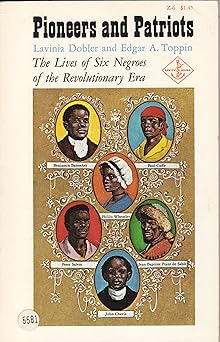
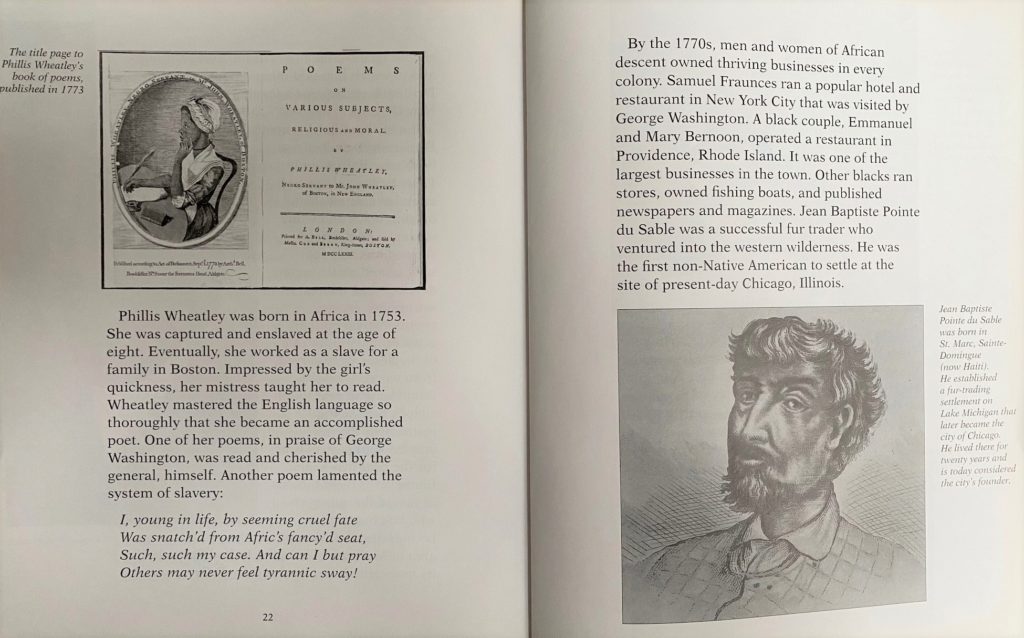
Pioneers and Patriots: The Lives of Six Negroes of the Revolutionary War by Lavinia Dobler – This is an old (1965) Zenith book, and we’ve enjoyed every one of their books that I’ve been able to get my hands on. The aim of Zenith Books was “to present the history of minority groups in the United States and their participation in the growth and development of the country.” Because the book is old, the word “negro” is used throughout. It has six chapters across 115 pages covering the lives of Peter Salem, Jean Baptiste de Sable, Phillis Wheatley, Benjamin Banneker, Paul Cuffe, and John Chavis. It has black and white illustrations sprinkled throughout. There is no preview on Amazon so here is a sample page.
Answering the Cry for Freedom: Stories of African Americans and the American Revolution* by Gretchen Woelfle – This 200-page book covers the lives of thirteen African Americans (Boston King, Agrippa Hull, James Armistead Lafayette, Phillis Wheatley, Elizabeth “Mumbet” Freeman, Prince Hall, Mary Perth, Ona Judge, Sally Hemings , Paul Cuffe, John Kizell, Richard Allen, and Jarena Lee) who were “inspired and inflamed by the radical spirit of their turbulent times…Some escaped to freedom with the British. Others fought hard for freedom and equality at home.” Note: Please pre-read the Sally Hemings chapter as it discusses sensitive details that your kids may not be ready for!
Which one should I use? It is certainly not necessary to use both Pioneers and Patriots and Answering the Cry as there is overlap in some of the people covered and either one can stand on its own. You really can’t go wrong either way if you’re debating between the two, but Answering the Cry is easier to find, has modern language, and highlights many more people so I recommend that one the most. If I wasn’t using Pioneers, I would read aloud from Answering the Cry and assign less chapters for independent reading for my older kids.




Biography Chapter Books
I’d love for each of my kids to hear all of these stories. Realistically, that won’t happen in a single school year, but I know that they will pick up additional stories and ideas as we continue building on our history studies through the years. My 3rd grader will read his books aloud to me, as he’s able, and I will read to him as well. My 5th and 6th graders will read their biographies on their own (I will schedule the weekly readings for them), but they are free to pick up the books and read any time.
Term 1
3rd grader: Crispus Attucks by Dharathula H. Millender
5th grader: The Kidnapped Prince by Olaudah Equiano
6th grader: The Story of Phillis Wheatley by Shirley Graham. This book was published in 1968, and it’s crazy expensive. I already had a copy, but I would never pay that much. [Update: Free digital copy available here] Check the Honorable Mentions down below for an option at a lower reading level. Otherwise, consider Hang a Thousand Trees with Ribbons: The Story of Phillis Wheatley by Ann Rinaldi for middle school or teens. That’s what I would have picked to investigate if I didn’t already have this book. Warning: I have not read Hang a Thousand Trees, and I know there is a love story involved. You would definitely need to pre-read to see how it is portrayed.
Term 2
3rd grader: A Voice of Her Own: The Story of Phillis Wheatley, Slave Poet by Kathryn Lasky
5th grader: The Story of Phillis Wheatley by Shirley Graham (same as above)
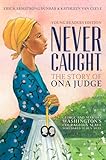
6th grader: Never Caught: The Story of Ona Judge by Erica Armstrong Dunbar- Never Caught has a sensitive part that mentions assault. Read the passage here so you can decide if you want to skip or discuss beforehand with your child.
Term 3
3rd grader: What Are You Figuring Now? A Story About Benjamin Banneker by Jeri Ferris
5th grader: A Free Woman on God’s Earth: The True Story of Elizabeth “Mumbet” Freeman by Jana Laiz – This is a quick read below her reading level because she will also need part of this term to finish up the Phillis Wheatley book.
6th grader: Never Caught: The Story of Ona Judge by Erica Armstrong Dunbar (continued from Term 2)




Picture books
These books are targeting my 3rd grader. He already knows about enslavement, in general, but this year I will continue to reveal more through these stories. I intentionally chose a mix of books highlighting various events and historical figures & characters because I want my son to know and respect the strength, contributions, and voices of women as well as men. Older children will also enjoy these picture books. The only reason I’m not including my older ones here is that they’ve already read these books (multiple times). I’ve noted how long it will take me to read each book (based on the premise of short lessons with time to orally narrate). The books are listed in chronological order.
Term 1
The Village That Vanished by Ann Grifalconi – “Young Abekenile and all the villagers of Yao feel safe sheltered deep within the jungle. But word has now come that slavers are on their way! Abekenile looks to the women of her tribe: her mother, who comes up with a clever plan to fool the slavers, and a tribal elder, who stays behind to face the slavers, steadfast in her trust that the ancestor-spirits will watch over her. But as the villagers retreat within the forest, it is Abekenile who finds that she too has the bravery and daring to help her people stay safe and free.” Please note: In this book, the young girl walks around bare-chested (not developed). It is most obvious in this picture. I will read this in two sittings.
Molly Bannaky* by Chris K. Soentpiet – “At the age of seventeen, this English dairymaid was exiled from her country and sentenced to work as an indentured servant in British Colonial America. Molly worked for a planter in Maryland for seven long years. Then she was given an ox hitched to a cart, some supplies-and her freedom. That a lone woman should stake land was unheard of. That she would marry an African slave was even more so. Yet Molly prospered, and with her husband Bannaky, she turned a one-room cabin in the wilderness into a thriving one hundred-acre farm. And one day she had the pleasure of writing her new grandson’s name in her cherished Bible: Benjamin Banneker.” I will read this in one sitting.
Dear Benjamin Banneker by Andrea Davis Pinkney – “Throughout his life Banneker was troubled that all blacks were not free. And so, in 1791, he wrote to Secretary of State Thomas Jefferson, who had signed the Declaration of Independence. Banneker attacked the institution of slavery and dared to call Jefferson a hypocrite for owning slaves. Jefferson responded. This is the story of Benjamin Banneker–his science, his politics, his morals, and his extraordinary correspondence with Thomas Jefferson.” I will read this in two sittings.
Term 2
Phoebe the Spy by Judith Berry Griffin – “Someone is planning to kill George Washington, and young Phoebe Fraunces is trying to save his life. Phoebe gets a job as George Washington’s housekeeper, but her real job is to work as a spy. She listens and watches very carefully, and she meets her father every day to tell him what she has learned. One day Phoebe’s father tells her that Washington is planning to leave town in a few days, and the person plotting against him will act before then. Phoebe is very frightened, but she is determined to figure out who is after Washington before it’s too late…” I will read this in four sittings.
Samuel’s Choice by Richard Berleth – “Samuel is a fourteen-year-old enslaved African American in Brooklyn in 1776 when the fighting between the British and the colonists reaches his doorstep. “Liberty ain’t for Africans,” says fellow servants. “It got nothin’ to do with us.” But his friend Sana says, “Nobody here’s gonna be free unless they take the risk.” Soon the well-equipped Redcoats have trapped ragged American soldiers, who have no boats to escape, and a terrible storm blows up. Samuel, a strong boatman, must decide what he should do.” I will read this in 3 sittings.
Term 3
A Spy Called James: The True Story of James Lafayette, Revolutionary War Double Agent by Anne Rockwell – “After his resounding defeat at the battle of Yorktown, British general Charles Cornwallis made a point of touring the American camp, looking for the reason behind his loss. What he didn’t expect to see was James, a runaway slave who had served as a guide to the British army. Or at least that’s what Cornwallis was led to believe. In fact, James wasn’t actually an escaped slave―he was a spy for the American army.” I will read this in one sitting.
The Escape of Oney Judge: Martha Washington’s Slave Finds Freedom by Emily Arnold McCully – “When General George Washington is elected the first President of the United States, his wife chooses young Oney Judge, a house slave who works as a seamstress at Mount Vernon, to travel with her to the nation’s capital in New York City as her personal maid. Eventually, Oney realizes she must run away. One day she sees an opportunity and takes it, ending up in New Hampshire, where she lives the rest of her life, poor but free.” I will read this in two sittings.
Mumbet’s Declaration of Independence* by Gretchen Woelfle – “Everybody knows about the Founding Fathers and the Declaration of Independence in 1776. But the founders weren’t the only ones who believed that everyone had a right to freedom. Mumbet, a Massachusetts enslaved person, believed it too. She longed to be free, but how? Would anyone help her in her fight for freedom? Could she win against her owner, the richest man in town?” I will read this in one sitting. It is a very quick read.


Historical Fiction Chapter Books
My 6th grader will read The Seeds of America Trilogy – Chains, Forge, Ashes. These books are so good, and I’m really looking forward to going through them with her. With 300 pages of dense text in each book, it is very unlikely that she’ll finish the entire series. Assuming she loves the books (I think she will!), she’ll likely choose to finish reading them in the summer when our lessons are much lighter or she can pick up where she left off the next time we hit this time period (or any other time). These books are absolutely appropriate for teens too!
The Arabus Family Saga – War Comes to Willy Freeman, Jump Ship to Freedom, and Who Is Carrie? – is for my 5th grader (one book each term). It’s an older series (1980s) written by the author of Newberry Honor book, My Brother Sam is Dead, which also takes place during the Revolutionary War. I picked these books for her because they’re shorter, less dense, and less intense than The Seeds of America books.
IMPORTANT NOTE: All six of the books here contain the brutal realities of slavery and other very difficult life circumstances and emotional trials. They have some heavy scenes so I only recommend them for middle school and up. My girls have been studying, discussing, and building up to these things with me for years. They both love historical fiction, and they will happily tear through these books. If your children are younger, more sensitive, or not ready for this material, these are probably not the best books for your family this year. Save these historical fiction Black history books covering Colonial America and the Revolutionary War for the next time you roll through this time period. You know your children best!




Morning Time (Composer study, Picture study, Poetry, Hymns, Folk songs, Short stories)
Term 1
Never Forgotten – “Set in West Africa, this a lyrical story-in-verse is about a young black boy who is kidnapped and sold into slavery, and his father who is left behind to mourn the loss of his son. Here’s a beautiful, powerful, truly unforgettable story about family, memory, and freedom.” This beautifully-illustrated book is naturally broken up into very short (one page with large print) sections, and I will just read 1-2 sections per week. This is an especially sweet selection for my family because it uniquely pairs one of our all-time favorite authors, Patricia McKissack, with one of our favorite husband-wife illustrator duos, Leo & Diane Dillon.
Term 2
No More! Stories and Songs of Slave Resistance – True vignettes and traditional verse, set against starkly powerful images, tell the story of enslaved Africans in America spanning the period from the early days of slavery to the Emancipation Proclamation. I will cover the entire book even though it extends beyond this time period. Please note: This book contains at least one instance of the n-word and a picture of a man in a disturbing metal collar. My 3rd grader will listen in on the stories with the family, but I will not show him that particular picture this year.
“A man who cannot swim leaps off a slave ship into the dark water. A girl defies the law by secretly learning to read and write. A future abolitionist regains his will to live by fighting off his captor with his bare hands: “I will not let you use me like a brute any longer,” Frederick Douglass vows. Drawing from authentic accounts, here is a chronology of resistance in all its forms: comical trickster tales about outwitting “Old Marsa”; secret “hush harbors” where Africans instill Christian worship with their own rituals; and spirituals such as “Go Down Moses,” whose coded lyrics signal not just hope for deliverance, but an active call to escape.”
Picture study: We will study Prince Demah for half a term of picture study because there are only three of his paintings available. He’s not mentioned in any of these Black history books covering Colonial America and the Revolutionary War, but I’ve shared my Prince Demah Picture Study resources. For the rest of the term, I’ll be covering Joshua Johnson Picture Study <<< Check out these posts for full details on studying each artist.
Term 3
Poetry: The Poems of Phillis Wheatley. If you’ve never read her work, you should definitely read a bit online before purchasing. They are not light poems. I remember trying to read them to my then six-year-old, and she just sat there staring at me. If you don’t mind studying poets in another time period (that never bothers me), I’ve shared several options for African American poetry here.
Composer study: Chevalier de Saint-Georges <<< Check out this post for full details on studying this composer for a term. The Other Mozart is out of print, but you may find it at the library or used. Before There Was Mozart is only available via Kindle. I like both books. You can’t go wrong either way.
Subscribe to Heritage Mom updates to receive an email when those resources are posted.




Books for Mama (and Teens)
Each year I try to choose a couple of books for myself that cover the time period we’re studying for school. These Black history books covering Colonial America and the Revolutionary War would also be great options for teens along with The Seeds of America Trilogy and possibly the Hang a Thousand Trees With Ribbons Phillis Wheatley book referenced above.
Strange New Land: Africans in Colonial America is my nonfiction choice for this year. “Engaging and accessibly written, Strange New Land explores the history of slavery and the struggle for freedom before the United States became a nation. Beginning with the colonization of North America, Peter Wood documents the transformation of slavery from a brutal form of indentured servitude to a full-blown system of racial domination.”
Strange New Land focuses on how Africans survived this brutal process–and ultimately shaped the contours of American racial slavery through numerous means, including:
- Mastering English and making it their own
- Converting to Christianity and transforming the religion
- Holding fast to Islam or combining their spiritual beliefs with the faith of their masters
- Recalling skills and beliefs, dances and stories from the Old World, which provided a key element in their triumphant story of survival
- Listening to talk of liberty and freedom, of the rights of man and embracing it as a fundamental right–even petitioning colonial administrators and insisting on that right.
The Astonishing Life of Octavian Nothing: Traitor to the Nation books are my historical fiction picks. “Young Octavian is being raised by a group of rational philosophers known only by numbers — but it is only after he opens a forbidden door that learns the hideous nature of their experiments, and his own chilling role them. Set in Revolutionary Boston, M. T. Anderson’s mesmerizing novel takes place at a time when Patriots battled to win liberty while African slaves were entreated to risk their lives for a freedom they would never claim. The first of two parts, this deeply provocative novel reimagines past as an eerie place that has startling resonance for readers today.”


Honorable Mentions
I own these Black history books covering Colonial America and the Revolutionary War, but I’m not planning to use them in the fall. The reasons for excluding them vary, but here is a quick explanation that may help in your evaluation as some could definitely be viable options for your family:
- My older kids already read America’s Black Founders, and it’s too detailed for my 3rd grader. It is a very informative book that contains stories and info I have not found elsewhere, but it is not riveting.
- They also read Revolutionary Poet when we previously studied Phillis Wheatley. A Voice of Her Own (shown above) is better for my 3rd grader because it is a bit easier to read and has more engaging illustrations.
- Come All You Brave Soldiers: Blacks in the Revolutionary War is a good book, but it includes a lot of detailed military information that my oldest daughter did not enjoy. We have The Black Regiment scheduled (shown above) so I don’t feel compelled to force this one. It will be on the shelf if someone is interested, and I suspect that my son will enjoy this when we swing back through this time period when he’s older.
- With only 75 pages, Black Heroes of the American Revolution could be a shorter replacement for Answering the Cry For Freedom and Pioneers and Patriots (both shown above), but doing all three would be overkill.
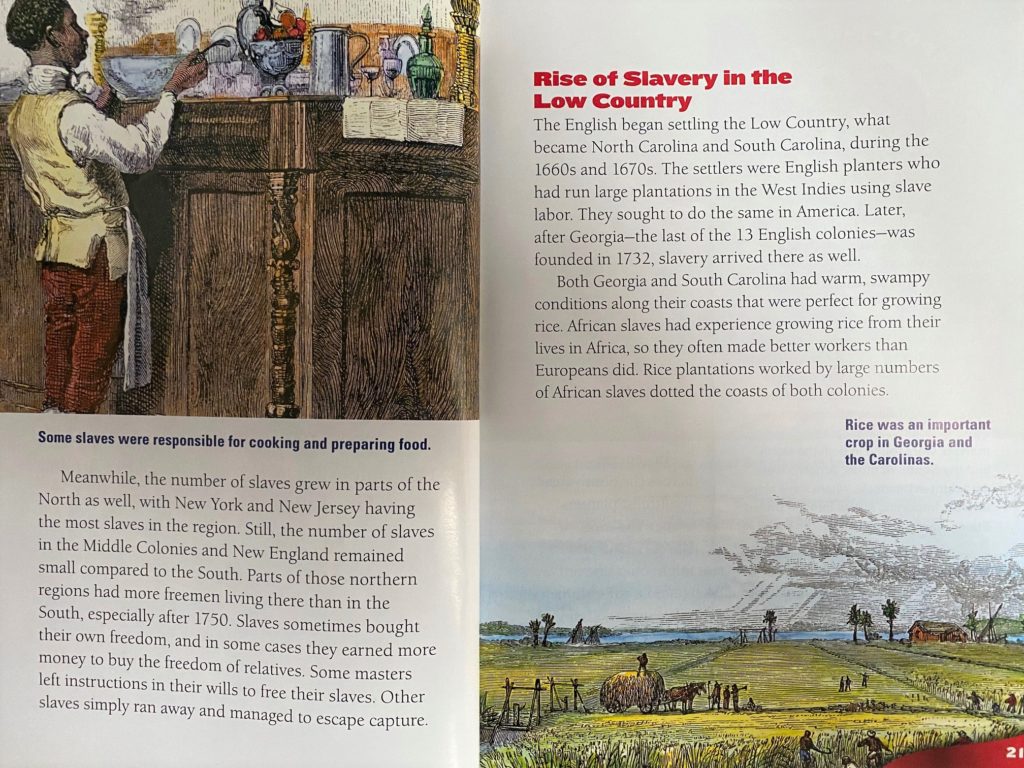
- The last two books are very similar in terms of content so you would never need both. These African-Americans in the Thirteen Colonies books are older and newer versions of the Cornerstones of Freedom series, but they are completely different books – different stories, different authors, and entirely different pictures. I don’t recommend one over the other; it just depends on your style preference. You can get a sense for the differences based on the covers, but you can’t look inside either one on Amazon, so I’ve posted a couple of photos below.


Additional Notes
* This time period corresponds to the following:
- Alveary (Charlotte Mason Institute) – Rotation 2 – 1650 to 1800 AD
- A Delectable Education – “Colonial American” – 1650 to 1800
- A Gentle Feast – Cycle 2 (Wars, Whigs, and Washington)
- Ambleside Online – Year 4 and Year 9
- CMEC – 1650 to 1800 AD
- Simply Charlotte Mason – Early Modern/Epistles (second half)
Reading schedule! I have a love-hate relationship with reading schedules: I love to have them and hate to make them. I usually end up marking pages on Sunday night for the following week, but I know that stresses a lot of folks out. As with last year, my awesome friend, Laura, has graciously shared the Colonial and Revolutionary War Black History Reading Schedule (books broken out by weeks and page numbers) that she’s put together using the books that I’ve listed in this post. THANK YOU, LAURA!!!
Want to see inside these books? Watch @thesimplehappylife flip through in this awesome video!
Disclaimer: I have not read every book cover to cover. I’ll eventually pre-read many of them, but I can’t do it all at once up front. I try not to share books here until after I’ve read them, but so many of my online and in real life friends are covering the same history time period in the fall, and they are ready to begin planning. Please know that if I find something egregious within the pages of any of my recommendations, I’ll run back here and update the post. I don’t anticipate that happening though because, as with last year, I have all of the books sitting here with me, and I’ve done a pretty thorough preview of the ones I haven’t read.
My prayer is that this post will save parents and teachers many hours of time researching Black history books covering Colonial America and the Revolutionary War for next school year. If you have other Black history books for the time period that you love, please drop them in the comments below so we can all benefit.
Feel free to ask questions in the comments below!
You can always find me on Instagram @heritagemomblog. See you there!
This is amazing! The CMEC will be covering the same time period this coming school year as well. 🙂
That’s awesome! I just added them to the reference at the bottom of the post. I really love that so many families will be working through the same time period together. It makes sharing ideas and resources infinitely easier (and better!)
This looks so rich!! I’m thinking this will combine really well with Beautiful Feet Early American if I do that in a year or two. Thank you for sharing all of your hard work!
-Emily, your insta friend 🙂
You’re welcome! Nice seeing you over here 🙂 I hope you are able to use it at some point!
Thank you! I appreciate the time and consideration you took to put this together. You are so generous to share it and I know that our history will be enriched by it. We are currently making our way through Amazing Africa and we love it!
You are so welcome! I hope that you’re loving Amazing Africa.
I’m looking through all your lists and plan to add some of these books to school and family read aloud time! I don’t know if you’re aware but Simonetta Carr recently published a book on Phyllis Wheatley for her “Christian Biography for Young Readers” series. She’s a friend and I was so happy she took on this project. It’s lovely, we’re reading that along with Phyllis’s poetry during our family evening read aloud time each night. It’s been a great addition, and I look forward to learning about more wonderful people from these booklists of yours! Like most people I am woefully ignorant but eager to expand my knowledge.
No, I hadn’t heard of this one! The cover looks lovely on Amazon, but unfortunately there’s no feature to look inside. I’m glad you mentioned here so others can see, and I look forward to seeing it when I get my hands on a copy.
Ooh, we loved Answering the Cry for Freedom. My kids each illustrated a quilt square (on graph paper) for each chapter (12 of the 13), and made a story quilt as a result. It was fun to see their symbols and representations for each chapter.
That’s a brilliant idea, Betsy! Thank you for sharing because I’m totally going to do this with my kids 🙂 I’m also glad to hear that you enjoyed the book. Now I’m looking forward to it even more.
I am curious to know your perspective on missionary biographies of missionaries to Africa- specifically the YWAM biographies, David Livingstone, Mary Slessor, Charles Mulli, etc. I realize this is not the topic of this article, I just didn’t know where else to ask.
It’s fine to ask here! The only one we’ve read is George Muller, so I can’t speak to the others. If the books demean the people they were sharing the Gospel with, then I can tell you that I won’t like them. If they’re told thoughtfully and honestly while respecting all image-bearers, I would probably enjoy them.
This is truly beautiful, friend! I am just praising God for you! Planning to do Mansa Musa, Sundiata and a wonderful African Princesses book I found for Term 3 this year (and into the summer), and then next year begin this list as another history stream. I am deeply grateful to know my children will have this as their education. THANK YOU.
You’re so welcome! I’m so glad you found these resources and that you’ll be able to use them in your home.
Free digital copy that can be borrowed for the rare Phillis Wheatley book: https://archive.org/details/isbn_0671325728
Oh Rachel, this will be such a blessing to other families! I’m going to add the link to the body of the post. Thank you so much for finding this. Because I already had the book, I didn’t even THINK to look there.
I don’t always check there, though I sometimes do when I’m not so interested in buying and I can’t find it at my county library. So thankful someone added it! Praise God! <3
Thank you for the hard work you’ve done to put this together! We’ll be studying the revolution next year and this is perfect timing.
Question: Would you say that “Answering the Cry…” is age appropriate for a 2nd grader? You mentioned that your older students would have assigned narrations, but I wasn’t sure if that meant your 3rd grader wouldn’t be listening to it as well?
Based on what I’ve read so far, I would say that it would be fine for a mature 2nd grader. Mature as in able to sit, listen, and be interested. It’s written in an engaging manner, but there are no pictures. It’s long, so I imagine that you could use it for 2nd grade and then again the next time you swing back through this time period, which is what I plan to do. My 3rd grader definitely will be listening in on it, but he will do oral narrations instead of written.
Excellent, thank you for the insight!
I have been eagerly waiting to come back to these when my kids were a bit older, and we are finally back in this history cycle. **Also adding your sweet tea plans in to the US geography set!
We live in a very un-diverse part of the nation, so your book recs provide so many touch points, conversations,and just fun books in the basket. Thank you
I love that you’ve been looking forward to them. I hope you enjoy the time period. And I think you’ll LOVE Sweet Tea – it’s still my kids’ all-time favorite.
Thank you so much for putting all of these resources together! I’m trying to provide my children lots of windows and it’s so helpful to have a list from someone who shares many of my values and educational philosophy. We really appreciate it.
You’re definitely welcome. I know how helpful the work other moms have shared has been for me, so I love being able to to pay it forward.
Thank you, Amber, for doing this list. I’m happy that I own a good portion of them in my lending library. And will keep working to add more of your recommendations. I value your careful evaluation. Thank you!
Sandy
Hall’s Living Library, Dallas, GA
You’re so welcome, Sandy. You have such a beautiful collection, and it makes me so happy to hear that you already have some of these. I know that you’re always on the lookout for quality titles. You are such a light and have diligently been doing this work for a long time. So thank YOU!
Have you seen or read this book?
One Gallant Rush: Robert Gould Shaw and His Brave Black Regiment by Burchard.
I guess that book is Civil War era.
I still appreciate the recommendation though because I had not heard of it!
I saved this post to read and savor. 🙂 Got to it today, and what a treat! Some of these I already own, and others I will be adding to our list. Ain’t no party like a book list party! Woohoo! Thank you for this time it took to assemble this, add pictures, and line it up with popular curriculums. My brother gave me a box of books a while back (I don’t know where he got them — he doesn’t even have kids 🙂 ), and the Laurie Halse Anderson trilogy was in there. I saved them because they looked really good. I’m happy to hear you liked them!
Best kind of party! Woohoo! Thank you for taking the time to read it and let me know that you liked it. This post was a BEAST to pull together, but it makes me smile every time someone lets me know that they will be able to use some of the info. That’s what it’s all about! And great find from your brother. Tell him to dump more wonderful books on you any time, lol.
Just wanted to share another resources for Black composers. We study violin and recently found this book: Music by Black Composers – voilin volume 1. It covers from the 1700s to the present and includes beginner to elementary level violin with 2nd violin or piano accompaniment. Each composer has a page or two with some background on their history.
There are also more resources on their website: https://www.musicbyblackcomposers.org/about-us/our-mission-story/
This looks like a WONDERFUL resource. Thank you so much for sharing it here as I had never heard of it!
Amber, this list is incredibly thorough and included titles I’d never heard of. Thank you once again for such a beautifully curated list!
You’re so welcome. I’m glad that you found a few new things!
Thank you so much for sharing! Your recommendations and Heritage packs have been invaluable to offering a robust multicultural history for my kids.
That’s music to my ears, Ashleigh. That is exactly why I share!
Thank you so much for your hard work in putting this together! I found you from following Jasmine Holmes on Instagram. We are using America’s Story in our homeschool, and I was saddened by the lack of diversity in the people highlighted. We are using Answering the Cry for Freedom to make our understanding of the American Revolution more rich. I also thought your warning to not only talk about slavery in terms of Black history is SO important. Our last library hall included biographies of black athletes, poetry from Black poets, etc. God bless you and your “love incubator”! 😉
I’m so thankful to Jasmine for sending people my way. Thank you for being here and for understanding and appreciating my work! And for blessing my “love incubator” – lol 🙂
I cannot WAIT to integrate this with our early American history studies next year! We use My Father’s World and will be doing Exploration to 1850. I’m determined for my children’s education to be well-rounded and honor all people! Thank you so much for such an excellent list!
You’re definitely welcome. It’s pretty cool that our families are on the same history rotation. That means that you’ll always be able to check here for recommendations that will be right on time, lol!
Amber, this is such a wonderful resource! I’ve revisited it several times since you posted.
Today I just wanted to make a quick note for you and others that while Answering the Cry for Freedom is WONDERFUL, I would definitely pre-read the chapter on Sally Hemming before passing it off to your children. It goes into detail about her relationship with Thomas Jefferson, which comes off complicated in the chapter and uses some language I wouldn’t choose to use with my own children. I hadn’t encountered that in several other chapters so far, so I was glad I happened to notice it while flipping through.
We opted just to skip that chapter and are reading about Ona Judge instead.
Also, not a book, but watching Liberty’s Kids (cartoon) has been such a delight for my children (Ages 4-8). It’s available free on YouTube but we paid the $22 on iTunes for the series because YouTube had so many ads. While it primarily focuses on the military events of the Revolutionary War, there are several episodes that focus on Black characters, including one on Phillis Wheatley and one on James Lafayette, and I believe there is an upcoming episode about Mumbet. I will confess I usually use that time to put away breakfast dishes or get dressed 😉 so I’ve not heard every word of the show, but what I have heard has been good.
Kelly, thank you so much for coming back to leave this note. I will add that up above in case some people don’t read the comments. The Sally Hemings story is terribly difficult to navigate with children, and I definitely want parents to have a heads up on that. And I hadn’t heard of Liberty Kids so thank you for that too! I’m always looking for good edutainment (lol) for my kids to enjoy. You’re ALWAYS welcome to add to the conversation here! I appreciate you. Oh, and I’m so glad that you like this resource. It took me just under a million hours to pull it together, so that made me happy 🙂
WOW! Just, wow. Thank you for sharing. What a labor of love this page is.
This is exactly what I have been looking for as I have been trying to curate our American history for next year and want to use mainly read alouds along with map work. I was looking at “Beautiful Feet Books” but felt uncomfortable with many of the books.
My question is, do you have a “spine book” for early American History or do you mainly use the books you’ve shared on your book lists?
Honestly, I haven’t found a spine that I love. I may end up using several different books to carry us through the timeline. I’m strongly leaning towards George Washington’s World by Genevieve Foster even though that’s usually more of a world history choice vs. pure U.S. history. Maybe I’ll pair it with a book on the Declaration of Independence and some picture books.
It’s great to see my former professor, Jim Haskins’, books on your list! He was my senior thesis advisor and professor at the University of Florida, and we kept in touch briefly until his death in 2005. He was a brilliant and excellent writer and literary advior.
Thank you. 🙂
Oh WOW. It must have been amazing to have him as a professor. His writing has been an incredible contribution to my children’s education.
In the second Jim Haskins book, Building a New Land, do you think the topics are too mature for an early elementary age child as a read-aloud? I’ve been struggling trying to decide if I should only place the picture books in my Colonial America discovery basket along with a few carefully chosen bios. My grandchild has really enjoyed your Melanated Tales Heritage Pack this year. We most likely will be doing the Amazing Africa Heritage Pack come this fall, but I want to have a discovery basket ready to counter anything she might learn elsewhere if my daughter decides to send her to public school. Your lists are amazing and I love them.
I would save Building a New Land until your granddaughter is older. My 3rd grader will probably end up hearing much of it because of the older siblings, but if he was my oldest or only, I would not be including the book for him until upper elementary.
We do not deserve you! You gave us EVERYTHING!!! I am so happy to search for those picture books for the girls especially. When they are older I will go for the other selections too.
Yay! Nothing makes me happier than knowing that other families have found something they can use and enjoy.
You are literally facilitating me being able to save my children’s souls. I mean that sincerely. I don’t have the time or wherewithal to find and compile these books and without fail, every time I’m looking for books to give my children perspective and images of themselves and their ancestors, you have provided it for me.
I found when I was searching to find a black homeschool group. I read your post and connected with everything you wrote. (Still haven’t found one here but keeping my fingers crossed.)
Anyway, just a big thank you and a hug for the path you have chosen to take. It is a blessing for my family!
Thank you so much for these kind words of encouragement. It makes me so happy to hear that my work is helping your family. That means everything to me!
This post is a godsend. I’ve spend the past several days working on designing a two-year history sequence for second and third graders for a homeschooling co-op that is about 50-50 black kids and white kids, and I’ve been scouring the internet for something, anything more than a small handful of picture books, that both talks about black Americans before about 1850 and is something that I could give to a third grader in good conscience.
The book recs themselves are fantastic, but the most important thing for me was probably the note at the beginning not to start with this period. I had realized that the kids needed to understand what came before America to understand American history, and was planning to spend second grade on a very rough survey of the ancient and medieval world before diving into American history in third grade. However, I am embarrassed to say that in looking at the periods that had the most children’s material written about them, I completely failed to include any deep dives into Africa outside of Egypt in that sequence. I am going to pare down the Renaissance and medieval European periods to make some space for medieval African kingdoms (and I feel much more capable of covering that material after also reading your post about Africa from 800-1650). Thank you so, so much.
You’re very welcome, and don’t be embarrassed! We didn’t learn these things in school, and it’s been quite a journey to uncover ideas and materials to help give our children a wider view of history. I’m really glad to hear that you got something out of this post, and I hope that the families in your co-op enjoy learning about these kingdoms.
Hi, I am looking for more historical fiction books about slavery before the Civil War for 4th grade. You mentioned the Arabus family saga, but I’d like something that is focused on the slavery in the southern colonies/states. Do you have any recommendations for that?
Hi, I have a few recommendations that may work on this page: https://heritagemom.com/2022/03/14/african-american-historical-fiction-stories-of-the-1800s/
This is such an incredible resource! I cannot believe that you offer this for free! I am so thankful for you and your work! We have worked through several heritage packs and are loving your hymn study pack. How delightful to see the.many ways that people worship God!
Thank you so much for enjoying and appreciating it! My hope has always been that these books will spread through homes and schools, and I love being able to share.
I am so thankful to find your blog! We are using This Country of Ours for history. We were reading the chapter on Bacon’s Rebellion. I typically like to find a good video or two to go with our history lesson and when I was searching for this chapter, there were so many on the African American involvement in this rebellion and the TCOO never mentioned anything about that. Honestly the one mention thus far into the book is the date the first slave ship came into the colonies but hasn’t mentioned anything about African Americans since. So I started searching for more perspectives and resources showing all peoples views of our history and that’s when I found your blog. Thank you for doing all of the work you have done and sharing it with all of us!! This is going to be so so helpful in balancing our history out.
I’m glad you found me, and you’re very welcome! I hope your family enjoys this expanded view of history.
Still here in 2026!! Even though I created my own Black History Curriculum for my homeschool children (ages 7, 10, 12, and 14), I still had very little to no resources when it came to literature. Talk about Picture books!! I cannot say THANK YOU AMBER enough for all your diligence. Your website has been my “Black History Backbone” of literature when it comes to supporting my homemade curriculum – Unstoppable. Amber, I owe at debt to you that I cannot pay!!! Thank you for pioneering before us with all your understanding and creativity.
You are soooo welcome! I LOVE sharing all that I’ve found, and it means so much to hear that other families are being blessed by it. I hope you enjoy these books!