
I’m the first to admit that Shakespeare was not something I was dying to teach my children. I remembered reading some of it in high school, and I very much felt like I could take it or leave it. However, by the time my oldest hit 2b (4th grade), I was ready to give it a try because I had a better understanding of why we would include his works in our lessons. By that time, my mind had been expanded. I’d learned more about his writing, and I was more willing to delve into unfamiliar territory.
As with many homeschool moms, I’m learning alongside my children as we explore all types of books and people. And while there are many reasons to study Shakespeare, there are just as many reasons to question the relevancy and wisdom of studying his work. I evaluated both sides of the equation and decided that the pros outweighed the cons, and we stepped forward with the following general plan:
- Read a summary or retelling. I chose Beautiful Stories From Shakespeare for Children by Edith Nesbit, and it has been perfect. At the beginning of each term, we read her retelling of the story to come. This helps us understand the main characters and plot before getting into the play.
- Watch a performance. Last term, we watched one of the performances after we read the play because the film was a complete departure from the actual setting of the play, but generally, we’ve watched the performance first.
- Read and listen. Finally, we read along with the play while listening to the Arkangel recordings. The recordings used to be free, and I downloaded them at that time, but I’ve also seen them available for temporary download on our library website if you don’t have Audible. I’ve sampled other recordings, but none have compared in quality to Arkangel. All of the plays are available to read in their entirety for free online. I buy Folger hardcopies for each of my children who are reading Shakespeare at this point, and I read along on the Folger Shakespeare Library online.




I’ve found this simple strategy to be one that works extremely well for my family, and in fact, my kids find Shakespeare to be very accessible and enjoyable.
I can’t even believe I just said that.
It’s true though. And it’s further proof that children often buy into what they hear other people say before they have the opportunity to form their own opinions.
My kids don’t know that many people consider Shakespeare to be “hard” or “boring.” I didn’t say anything positive or negative about him when we picked up the first book. I let the work and our process speak for itself.
At first, I wasn’t sure what would happen, but if I had had to place a bet back then, I would’ve expected them to hate it. Why? Because I hated it when I was in school.
Well, I was totally wrong, and I’m glad I knew enough to keep my mouth shut. For once. {smile}
Normally, this would be the end of this post, but you all know me better than that. I take every opportunity to look for ways to relate our studies to our culture in order to offer mirrors to my children. And I suspect that could be part of why they feel that Shakespeare is for them.
Here are just a few examples of how we are making Shakespeare a multicultural adventure in our home:
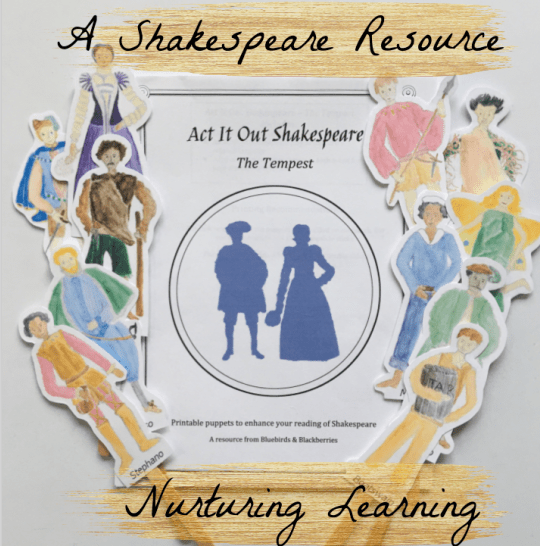
For The Tempest this year, we’re using Act It Out Shakespeare. The download comes with 11 printable multicultural puppets to help us keep track of the characters as we go along. The watercolor images are lovely, and I LOVE that the artist chose to use diverse images. This may seem like something small, but it is everything to my family – mirrors and windows all in one!
Designed by my friend’s twelve year old daughter (Homeschoolers rock!), these will be just the right thing to help my children imagine a rainbow cast of characters as we read.
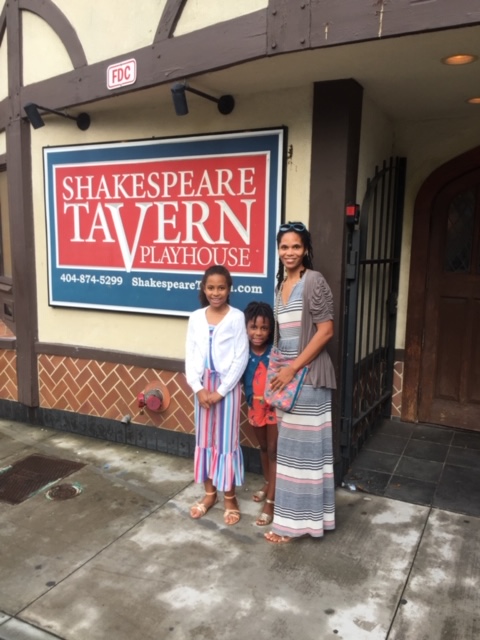
Last summer, when I saw the promotional images from The Shakespeare Tavern Playhouse, I noticed that the A Midsummer Night’s Dream had a very diverse cast. Puck was Asian, Helena was Black, and the rest of the cast featured a mixture of pretty much everyone. I bought tickets right away, and my girls were absolutely delighted!
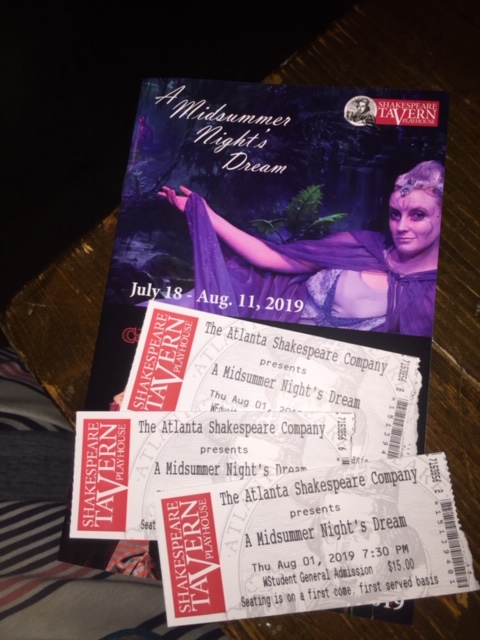
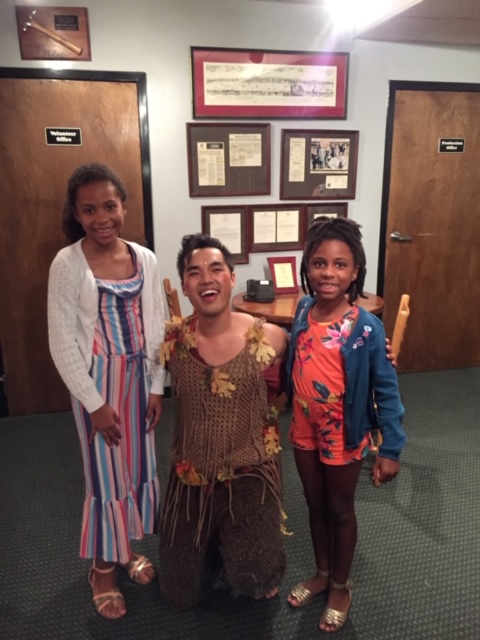

For As You Like It, we watched the 1936 black & white movie before reading the play, and the 2006 film set in 19th century Japan after reading the play. I picked this particular film for its setting and because Orlando de Boys is played by Black actor, David Oyelowo. I was disappointed that there were very few Japanese people in the film because it actually takes place within a European colony in Japan (kinda weird), but I was otherwise pleased.


And for Term 2 this year, we’ll be watching this PBS Great Performances version of Much Ado About Nothing with a modern spin and a Black cast. I haven’t watched the entire thing yet, so definitely preview before sharing, but I’m beyond excited to grab some popcorn and dig into this with my kids.
Yes, unicorns do exist!

These are just a few of the ways that I’ve tried to make Shakespeare less of a faraway thing and more of a gateway to a world where my children can soak up the literary goodness, discard the nonsense, and imagine themselves as part of it all.
My girl has loved Shakespeare since she was 8 and we used an approach similar to yours! We read a story version of the play in modern English, we watched the real production from the library then went to see a live version! We have access to a university area committed to using a diverse cast and it’s been so good. And we watched the As You Like It from PBS too!
If you also want to incorporate memorization the book “How to Teach Your Children Shakespeare” by Ken Ludwig has been so good! We used this to dress up and perform for our co-op (virtually) this year.
I’m new to your work, thank you!
You’re welcome. I’m glad that you’re here! I saw Ken Ludwig’s book linked from another blog, but there was no explanation, and I forgot to follow up. Thank you for the recommendation and the reminder.
Does your friend’s daughter have printables for A Midsummer Night’s Dream? Please, please, please????
My daughter is working on A Midsummer right now! It should be ready by middle of next week. If you follow @nurturinglearning or @bluebirdsandblackberriesstudio on Instagram, we will announce the release of Midsummer’s Night Dream.
Love this! We just read and then watched The Merchant of Venice as a family and had a ball! We were able to wrestle with the flaws of the human condition demonstrated by several of the main characters and discuss these as a family in the light of Biblical truths in both the Old and New Testaments. Such a rich experience!
Absolutely. We watched that one too! In fact, I meant to share the time stamps for where to pause/skip in order to avoid the bare-chested ladies. That was a really good movie.
I watched that production of Much Ado About Nothing earlier this year and enjoyed it immensely! It made me decide to tackle Shakespeare this fall. PBS also has another series called Shakespeare Unshackled which provides background info to each play. A great resource for parents and older teens.
http://www.pbs.org/wnet/shakespeare-uncovered/
NICE! Thank you so much for sharing that resource, and I’m excited to hear that you liked that production. Now I’m looking forward to it even more.
I’m curious if you showed the As You Like It movie to all of your kids. I often have trouble finding movie versions that work for my younger kids as well as my teens, so I’d be thrilled to hear if this worked for everyone.
Yes, I did, but we watched the 1936 one first: https://www.youtube.com/watch?v=wFChichBoPI. I actually completely forgot about that until I just looked back at my notes. I’m going to update the post when I get the chance because we really liked the old version. In the 2006 version linked on the post, it was mostly fine but I recall a few scenes with some gratuitous flirting that I wished weren’t in there. I also felt like the movie did absolutely no justice to Japanese culture, leaving me to wonder why they chose that as a backdrop if they weren’t going to include any real Japanese culture in the film. I hope this helps!
I love this! We have enjoyed Shakespeare a lot sense my oldest was about 8. We too read the lamb version, listen to the arkangel recordings while following along with Folger 😊 we watched one play live on the river and hand watched some movies but not sure which productions are best. My oldest last year wrote a play for the kids to reenact was the midsummers nights dream.
My oldest is doing Julius Caesar this year 1st sense we are doing ancient history and Greeks and Romans. But can’t find a good kids version?
I recommend this one for Julius Caesar. I haven’t used it yet myself, but it came highly recommended to me, and this is what I plan to use when we read that play: https://amzn.to/3bt6MZy